
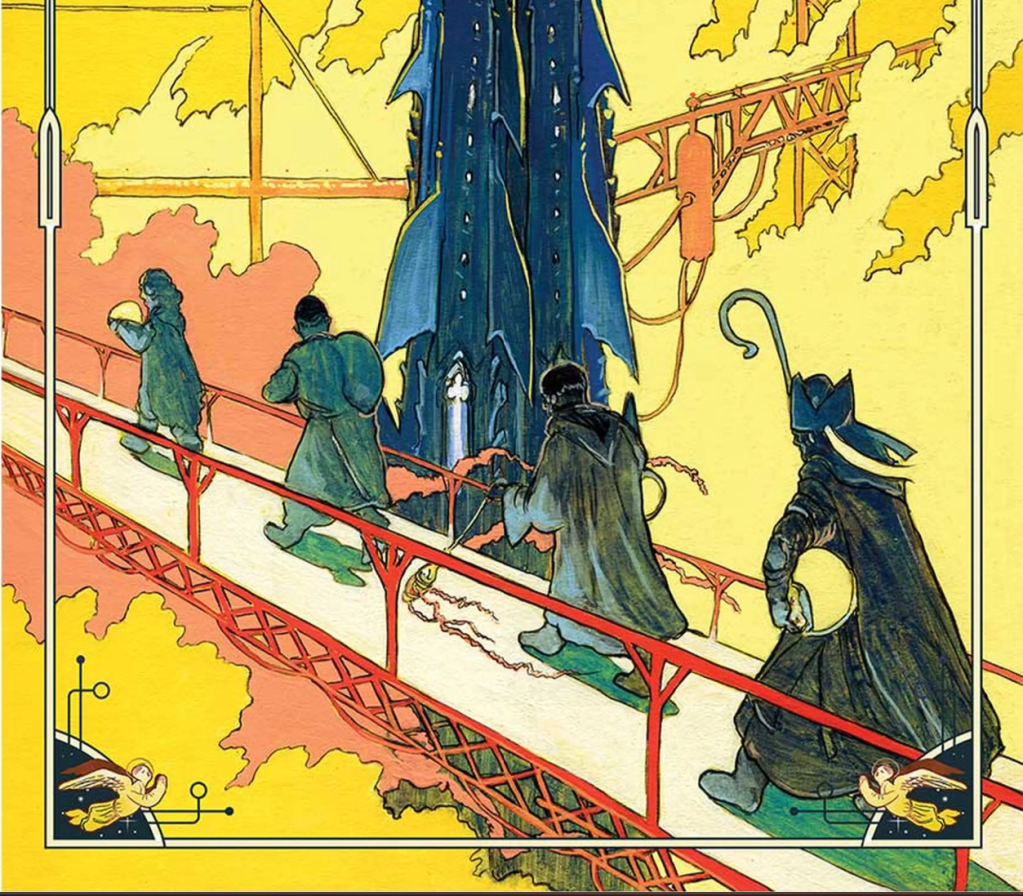
The Folio Society edition of Walter M. Miller Jr.’s A Canticle for Leibowitz ($100) is an ambitious release that takes big swings when it comes to design. In addition to a psychedelic color palette, it attempts to match a masterpiece of post-apocalyptic science fiction with a presentation reminiscent of a monastic relic. As such, this edition was designed to embody one of the novel’s themes: the preservation of knowledge during a dark age.
The result is a compelling design that captures the novel’s unique blend of dark humor and tragedy, making it a must-have for Foliophiles and discerning sci-fi collectors alike.
Slipcase
Rating: ★★★★★ (5 out of 5)
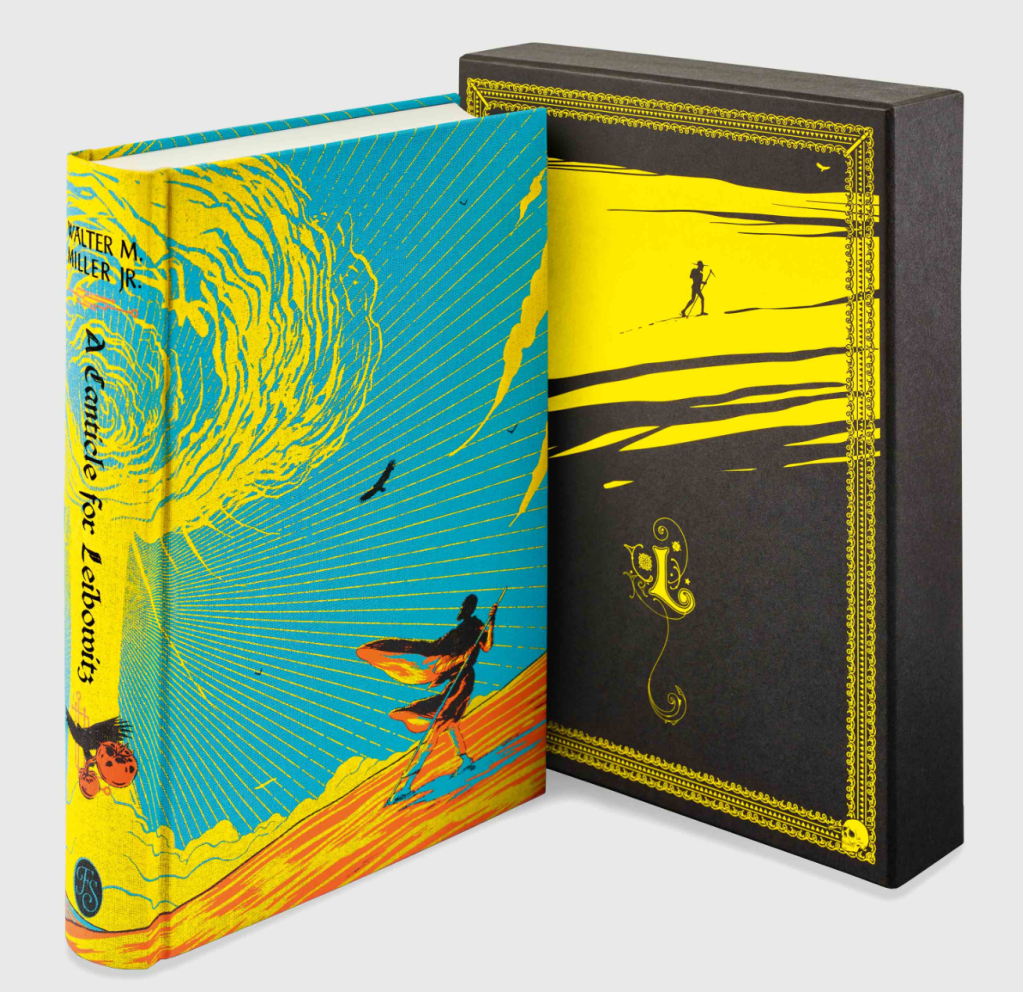
Printed and blocked with an original design by illustrator Elliot Lang, the slipcase provides a hint of the medieval illumination and technical relics contained within. It elevates the presentation to something resembling a holy vessel — a perfect container for a book that treats blueprints and grocery lists as sacred texts. While some modern Folio slipcases are dyed but unadorned, it’s always nice to see an original design that compliments the spine and adds another visual element to the overall presentation.

Covers & spine
Rating: ★★★★★ (5 out of 5)
The book itself is bound in screen-printed and blocked cloth that has a really pleasing grain, without any fuzziness or pilling, alongside a visually striking color palette by Lang that doesn’t look like anything else on my shelves.
The cover nicely evokes the novel’s anachronistic setting, depicting what appears to be a medieval monk witnessing a nuclear explosion, alongside patterns that reference the intricate, hand-copied texts of the Albertian Order of Leibowitz. There are also some subtle nods to the novel’s narrative here that I won’t spoil for anyone who hasn’t read the book.

Paper & type
Rating: ★★★★☆ (4 out of 5)
The text block is offset-printed on Abbey Pure paper, a fitting choice that alludes to the central Abbey of the novel. It’s about as clear and crisp as you can get without letterpress printing. The first printing copy I reviewed was printed at Memminger MedienCentrum AG, Folio’s favorite German print shop.
The binding is Smyth-sewn by Germany’s Josef Spinner Grossbuchbinderei GmbH (first printing) with wound endbands in black silk. The page edges are unadorned but the endpapers are printed with a clever in-universe schematic.
The typeface is set in Kristal with Rotunda Veneta as a display font. Kristal provides a clean, contemporary readability, while Rotunda Veneta — a calligraphic, medieval-style font — perfectly bridges the old world of the monks’ relics with the modern context of the story.
Illustrations
Rating: ★★★★★ (5 out of 5)
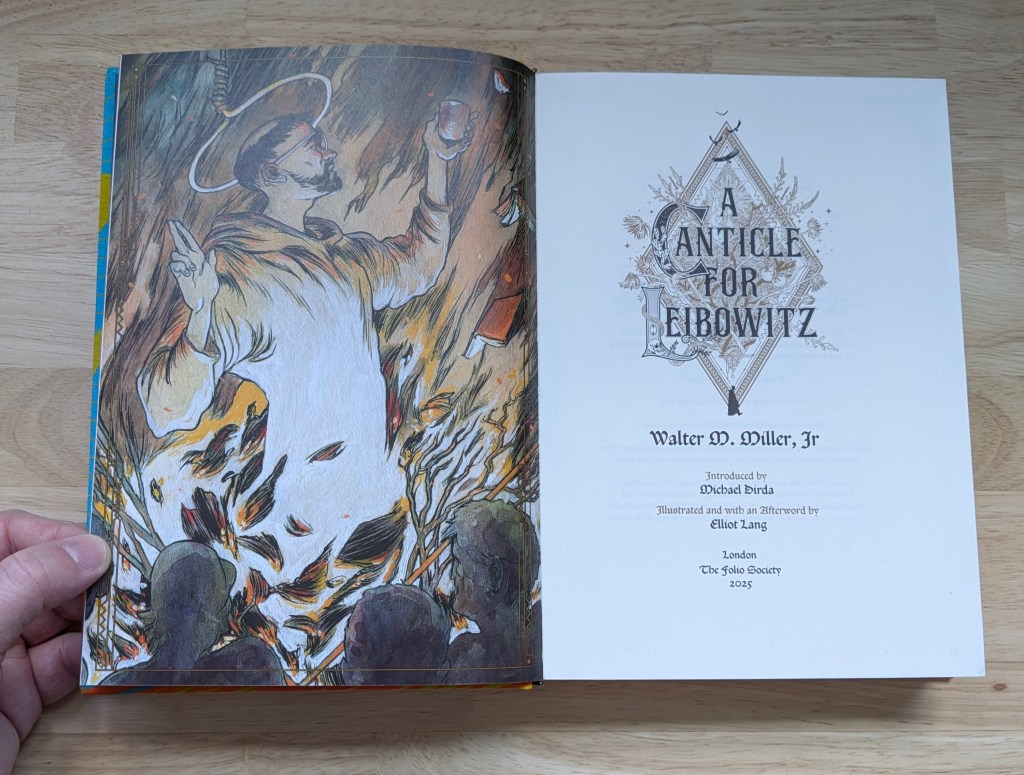
Elliot Lang’s artwork is the defining feature of this edition, including an illustrated title page, three part-titles, a frontispiece, and 11 full-page color illustrations (including two double-page spreads), alongside thirty drop-cap illustrations that appear at the beginning of each chapter.
Lang’s medieval style uses bold lines and a vivid color palette reminiscent of stained glass or illuminated manuscripts. His depictions of the post-apocalyptic desert, the devoted monks, and the slow re-emergence of technology are faithful to Miller’s vision. At first glance it might seem an odd fit for a science fiction novel, but it’s perfect for A Canticle for Leibowitz and brilliantly captures the novel’s satire of humanity’s inability to learn from its past, portraying futuristic technology with the solemn, sometimes bewildered, reverence of a dark age monk.

Text
Rating: ★★★★★ (5 out of 5)
Walter M. Miller Jr.’s Hugo Award-winning novel, A Canticle for Leibowitz, was first published at the height of the Cold War in 1959. It’s a chillingly prescient and deeply philosophical meditation on the cyclical nature of history, knowledge, and faith in the wake of nuclear disaster.
Spanning centuries and told in three distinct but interconnected parts — “Fiat Homo,” “Fiat Lux,” and “Fiat Voluntas Tua” — the novel is both wickedly satirical and profoundly tragic. Miller’s prose masterfully blends the absurd with the sublime, and his exploration of humanity’s inherent flaws remains one of the most intellectually rewarding and unforgettable novels of all time.
This Folio Society edition also includes a new introduction by Michael Dirda, the Pulitzer-winning book critic, and a new afterword by the artist, Elliot Lang, both of which increased my appreciation for the novel and this particular edition.
Overall
Rating: ★★★★⯪ (4.8 out of 5)
The Folio Society’s edition of A Canticle for Leibowitz is an extraordinary work of sci-fi art that pays respect to a literary classic. From the thoughtful choice of paper and type to the brilliant use of gold ink and Elliot Lang’s perfectly anachronistic, medieval-inspired illustrations, every production element enhances the core themes of the novel. It is a stunning visual and tactile experience — an edition that truly feels like a relic the monks in the novel would strive to preserve.

 Alderbrink