

Without hyperbole, Madeline Miller’s Circe (2018) is one of my favorite novels of the 20th century, so I was particularly excited when the Folio Society announced a $95 collector’s edition as part of its Summer 2025 series — one year after it published Miller’s previous Homer-inspired novel, The Song of Achilles (2011).
The result is one of the best fine press editions of the year so far thanks to gorgeous design elements, illustrations, and production details that capture Madeline Miller’s atmospheric sense of place.
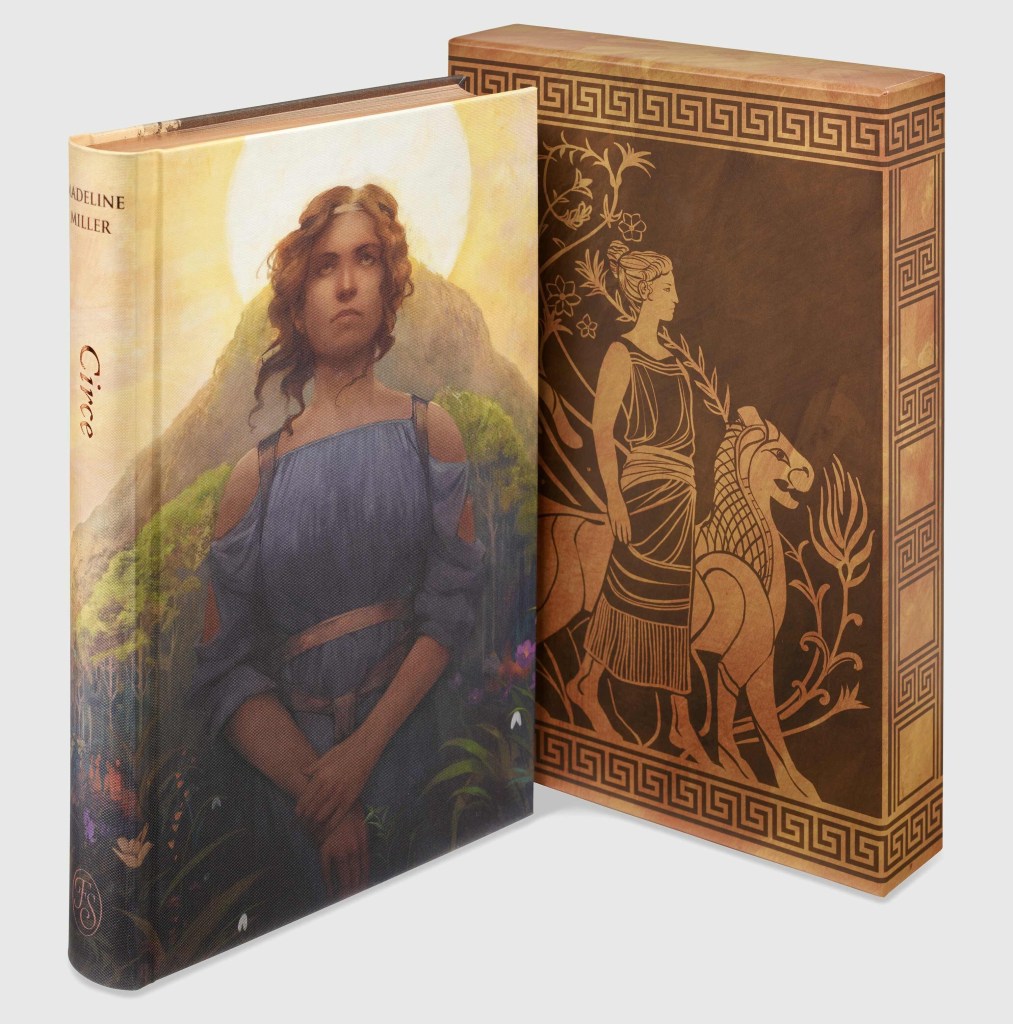
Slipcase
Rating: ★★★★★ (5 out of 5)
The printed slipcase is a nice homage to the black-figure pottery and decorative “meander” borders that were popular in ancient Greece. The image of Circe alongside one of her lions — as well as the flora unique to her island, Aiaia — is a clever piece of visual foreshadowing. And while many older Folio slipcases were covered with binder’s board, this slipcase is laminated with a slightly glossy matte cover that’s smoother to the touch.
Cover & spine
Rating: ★★★★★ (5 out of 5)
The book itself is bound in printed and blocked cloth, which offers some grain without being coarse, and shimmers with a subtle iridescence when you rotate the book on an axis. The cloth does feel ever-so-slightly fuzzy, and it is not buckram, which some Foliophiles prefer for its texture and firmness.
The Homeric cover design by Julie Dillon looks like an inverse of Caspar David Friedrich’s Wanderer above the Sea Fog. The color palette is rich and evocative, featuring deep blue and earthy red accents reminiscent of ancient Greek frescoes and the Aegean Sea.
The spine is my favorite aspect of the presentation — a gorgeous slice of Aiaia beneath the debossed and gold-foiled title. Thanks to shared design elements, this Circe looks great next to the Folio edition of its sister novel, Miller’s The Song of Achilles.

Paper & type
Rating: ★★★★☆ (4 out of 5)
Like all Folio editions, Circe‘s text block was printed on paper “sourced from certified paper mills who obtain fibre from responsibly managed forests.” The first printing copy of Circe I reviewed was produced with Abbey wove paper from Memminger MedienCentrum AG, the German print shop behind many of Folio’s best works in recent years.
The page tops are gilded, while the edges (trimmed) and bottoms are unadorned. The endpapers are blank, though their clay-red color is a nice nod to the terra rosa of the Mediterranean. (The endpapers of Little, Brown & Company’s original hardcover in 2018 featured a stylized map of Aiaia that I loved.) The pages feel crisp and substantial, without much bleed-through.
The binding is Smyth-sewn by Germany’s Josef Spinner Grossbuchbinderei GmbH (first printing) with wound endbands in alternating gold and bronze silk.
The text is set in Apollo, a typeface designed by Adrian Frutiger at Monotype in 1964 — and a perfect choice for the story of Circe, who is technically a distant cousin of Apollo in Greek mythology (he appears in the novel, too).
There is no ornamentation — such as chapter headpieces, vignettes, or graphic initials — on the pages between illustrations. (The solar symbol, likely a reference to Circe’s father Helios, that accompanied chapter headings in the original hardcover is not present here.)

Illustrations
Rating: ★★★★★ (5 out of 5)
Julie Dillon, celebrated for her work on Folio’s edition of Miller’s The Song of Achilles, returned to illustrate Circe, and her six full-color illustrations — including one stunning double-page spread — are another of the edition’s highlights. Additionally, a black-and-white illustration graces the title page.
Dillon’s artwork here is Romantically stylized and consistent with her Achilles illustrations. Her depictions of Circe, her island, and the various mythical figures she encounters are both faithful to Miller’s descriptions and imbued with a cinematic sense of drama. The color palette is rich with glowing hues that evoke the magic and mystery of Circe’s world.
Text
Rating: ★★★★★ (5 out of 5)
The heart of this edition is, of course, Madeline Miller’s Circe. Published in 2018, the novel quickly became a literary phenomenon, captivating readers worldwide with its masterful reimagining of the Greek myth — and spawning countless clones. Banished to the Aegean island of Aiaia for her witchcraft, Circe’s story unfolds as a journey of self-discovery and motherhood.
Miller’s prose is lyrical and evocative, blending classical scholarship with contemporary storytelling sensibilities. Circe is a testament to the enduring power of myth and the strength of a woman forging her own destiny in a world dominated by gods and men. It’s one of the most memorable novels I’ve ever read.
Overall
Rating: ★★★★⯪ (4.8 out of 5)
The Folio Society’s edition of Circe is a triumph of bookmaking. Every element, from the Greek-inspired design motifs to Julie Dillon’s stunning illustrations, contributes to a truly exceptional volume. This is not just a book to be read, it is an object to be cherished — a collector’s piece that thoughtfully encapsulates the magic and sense of place in Madeline Miller’s unforgettable novel.
FICTION
Circe by Madeline Miller
The Folio Society collector’s edition
Published June 5, 2025
408 pages
9.5″ x 6.25″
Alderbrink rating: ★★★★⯪ (4.8 out of 5)

 Alderbrink